January 29, 2012

Brake bed-in Procedure

(updated on Feb. 1st 2012)

Before bed-in
New brake pads and skimmed rotor were installed in place.

In order for the new brake set to work at its best, the rotors and pads should be properly bedded-in. This process can also be called as "brake conditioning", or whatever terminology.

Proper bedding improves pedal feel [no "on-off" braking feel], reduces or eliminates brake squeal, prevents and cures brake judder, reduces brake dust, and extends the life of pads and rotors.

If you Google around, you will find different procedures for brake bed-in. You may follow any of those procedures but I've got my own way of doing it. You don't have to follow my way but you can take a peep... :)


myProcedure for Bed-in

Bed-in procedure can be annoying to other drivers so I had to perform the bed-in around 4:00am to 5:30am in two sessions during which time there is virtually no other vehicle on the road.


1st Session

Drove and accelerated the car to approximately 80kph and then applied the brake lightly until the speed dropped to around 20kph in 100m. Then accelerated back to 80kph and maintained the speed for 1 minute and then applied the brake lightly again. Repeated 10 times without completely stopping the car. After 10th braking, drove the car slowly for another 5km to cool down the pads and rotor before stopping.

Stopped the car for 30minutes to almost completely cool the brakes.

2nd Session
Repeated Session 1 at 110kph

Here is the result after the 2nd session...

... there is a slight blue tint on the rotor [disc] surface which is not in contact with the pad and a light grey film on the surface which is in direct contact with the pad.


The blue tint tells the rotor has reached break-in temperature and the grey 'coating' is the by product of the chemical reaction between pad material and the rotor under extreme temperature and pressure. This layer enhances adherent friction hence minimizes squealing, increases braking torque, and maximizes pad and rotor life. Without which the braking force depends solely on abrasive friction.


3rd Session
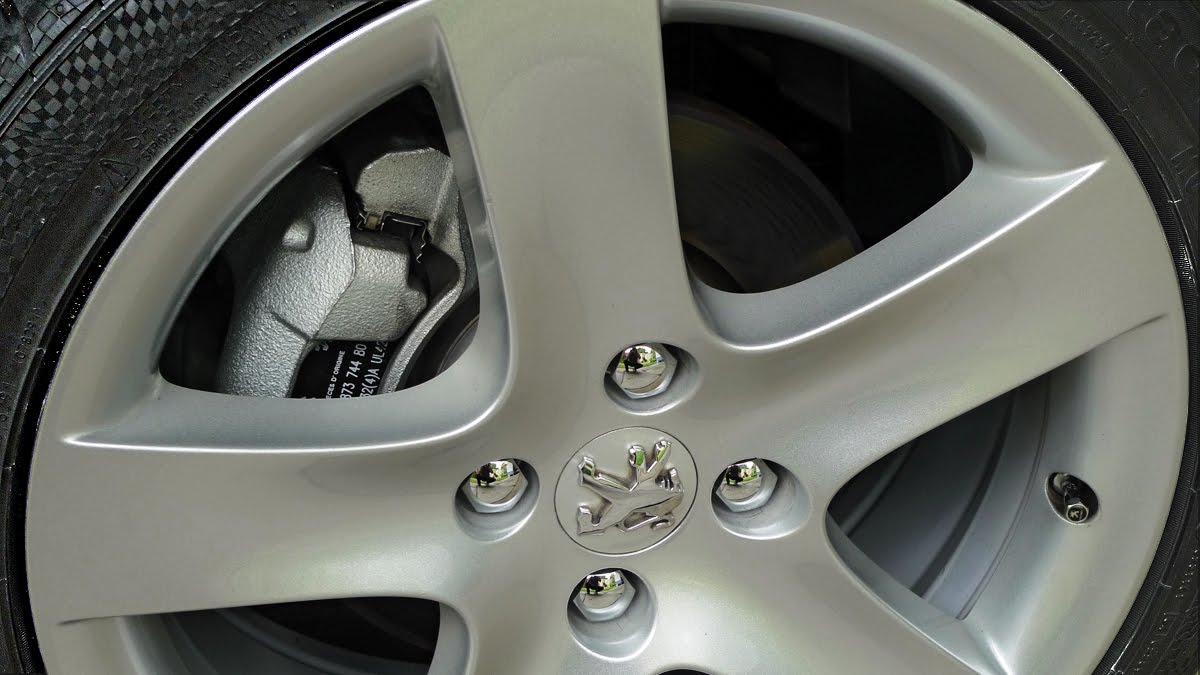
For the 3rd Session, the car was driven 122km non-stop. During the first 50km the car was driven and braked normally in order to "bake-up" brake pads and rotors gradually and maintained the temperature and then performed THREE hard braking from around 120-140kph down to 20kph .

Fully baked rotor with near perfect transfer-layer* formation...
*click HERE to find out what transfer-layer is all about and its significance.
4th Session
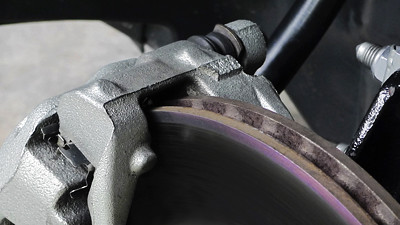
This was the final session. The car was driven for 382km at 'normal speeds'. Four times hard braking to dead stop was performed during the trip at approx. 50km interval. Braking performance was excellent. The best ever! Silky smooth but sure and firm. Adherent friction is superb.

Rotor condition after brake bed-in [conditioning] process was completed...
Brake rotor bed-in

January 27, 2012

What Brake Bed-in is all about...

Many ppl believe that brake bed-in is just the grinding process to make the brake pad and rotor [disc] rubbing surfaces match together perfectly for optimum abrasive friction.

Brake bed-in is actually more than that. I prefer to call it 'brake conditioning' because apart from grinding the process will also involve depositing of an even layer of coating material on the rotor surface [for adherent friction] as a result of chemical reaction between brake pad material and the rotor metal/alloy under extreme pressure and temperature. Without which the pads and rotor will be subject to excessive grinding hence reduce their life span. That's why some ppl who did not do proper 'brake conditioning' had to replace their brake pads/rotors sooner than the others either due to excessive wear & tear or juddering/vibration or both.

Proper 'brake conditioning' is important in order to optimise both abrasive and adherent friction for the best braking performance as well as to prolong life span of brake pads/rotors and to prevent brake judder, noise, vibration, etc...

How to do Brake Conditioning?
Just Google around. There are lots of different procedures available. Pick the one you think is suitable for you.

Remember ...
"Proper bedding makes it lust longer..." :)

Taking a Brake...

MyPeugeot308 is almost 3yrs OTR and has just clocked 50,000km. Prior to the scheduled service it is the right time to replace front brake pads even though all pads are still usable up to at least 6000km more.

comparison between worn-out and fresh front brakepads

Why 6000km more?
The answer is because the remaining pad thickness is still more than 1 mm above wear limit. For instance, by measurement the average brake pad consumption is around 1 mm/6000km. This guide is valid for genuine pads and only if 308T is not driven on busy streets [or in towns/cities] where the right foot is spent more time on brake pedal than on the accelerator!.


Ready for the installation.
There is not much wear/damage on the stock rotors even after 50,000km of 'abuse'. A little skimming job is good enough to 'recond' them.
I still prefer genuine brake pads.

DIY Installation is complete...


Click HERE for more info on brake pads/discs and to see how to remove them.

January 23, 2012

One-Half Marathon

By definition One-Half Marathon is a road running event of 21.0975 kilometres (13.1094 mi).

To us, "One-Half Marathon" means driving around 750km on a single trip. We usually drive around 1500km or 750km or at least 380km on a single return trip [we call them... full, one-half and one-qtr "marathon" respectively]. Anything less than that we don't call a "trip" and we usually don't follow.

This month we went on a day trip to Desaru from BBBangi. Total distance travelled was 763km.
Despite of holiday traffic congestion we managed to burn less than one-tank of RON95 fuel for the trip (to and fro). There was a "bip" followed by Low Level warning light came in as we approached near Seremban but the remaining fuel could take us more than 100km and sufficient enough to reach our home in BBBangi!
On return trip we felt there was a slight reduction in "pulling power" at high rpm [beyond 4000 rpm]. Luckily we brought along OBD2 gadget and found out there was a "Pending fault - lean fuel mixture at full load". After resetting the "pending fault" the car performed as usual. QED!

January 07, 2012

PCMSCAN

PCMSCAN is just another OBD-II scanner and diagnostic tool for viewing, charting, logging and playback of diagnostic data in real time via the vehicle's OBD-II diagnostic data port. It also allows viewing of vehicle Diagnostic Trouble Codes (DTC's), Freeze Frame data, and other vehicle information.

Unfortunately for myPeugeot 308T, PCMSCAN supports only 17 out of 110 available PIDs.

Nothing much to play around. Nonetheless it is still useful for monitoring and logging some of the the critical data, besides displaying "trouble codes" and able to reset 'em, if exist.
BTW, I'm using 'plug and play' ELM327 USB for the interface.

January 05, 2012

Garmin® ecoRoute™

ecoRoute™ is a new feature for Garmin GPS navigators which allows users to find more fuel efficient routes when navigating and even track fuel usage. ecoRoute™ is available for Malaysia-Singapore version of nuvi 2575R that I'm using at the moment. With ecoRoute™, it is useful to save petrol and money by adopting smarter driving habits.

ecoRoute™ was tested for the first 500km drive [from BB Bangi to Kuala Perlis] during the previous 1500km trip to the Northern and North-Eastern states of Malayan Peninsular. The car was driven on auto-cruise without exceeding speed limits most of the time.

The screen capture below shows some of the ecoRoute™ applications.
echo-route
There would be fuel report which tracks fuel usage over time, and mileage report which monitors mileage and fuel usage on a per-trip basis.
ecodrive bbb-kperlis

Fuel consumption trend for the 5hr drive
31788 BBB-KPerlis fuel consumption

the ecoChallange™ score chart...
38355- eco driving BBB-KPerlis
The drive was trying to keep the score as high as possible. Well >80% is 'A' already... :)

1500km-trip - Overall fuel Consumption trend
20hrs - 1596km  drive
Fuel: RM231.42@ RM1.90/liter
Distance: 1596km
Avg fuel consumption: 7.63liter/100km or 14.5sen/km

Note: ecoRoute™ is NOT ecoRoute™ HD . Not withstanding, the later would be the most logical upgrade. Stay tuned!

Last 7-day Most Viewed Pages

All-time Most Popular Posts